

A hugely successful Budapest confectionery closed down tragically early
Architectural and graphic quality played a major role in the creation of Floris, a Hungarian confectionery brand from the
Architectural and graphic quality played a major role in the creation of Floris, a Hungarian confectionery brand from the 1920s that, despite its short lived existence, achieved remarkable success. The story, which began in Budapest and later faltered, ultimately reached its peak in London.
“Great Britain’s wartime prime minister celebrated his 86th birthday on November 30. In recent years, Churchill’s birthday has had a Hungarian connection. For many years now, the Floris confectionery has made his birthday cake every year. Mrs. Floris, the former owner of the famous Budapest confectionery, settled in London after World War II and became just as well known among the English as she had been in Hungary. This birthday cake is a social event in itself every year. Each year it is made from different materials, and its appearance remains a strict secret until the last moment. However, interest is so great that a day before the celebration, the Floris family presents Churchill’s cake to the press. A formal press event is held, where radio, television, and journalists can view the masterpiece.” (Uj Hungária, December 9, 1960)
This is how the Munich based independent weekly Free Hungarians reported on the outstanding London event with Hungarian ties though with one inaccuracy, as the owner had actually settled in London as early as 1934. By then, the Floris confectionery family name, once so popular in Budapest, had largely faded from public memory, remembered mostly by older generations. Today, the story of this confectionery family marked by brilliance and downfall is almost entirely unknown, despite their pioneering role not only in creating beloved sweets but also in emphasizing modern business structures and the design of elegant shops and packaging.
Bonbon wrappers and decorative boxes
From the legacy of this modern-minded confectionery family, little physical evidence remains beyond a few finely designed chocolate boxes and packaging papers. Descendants researching their story presented the world of Floris confectioneries to the public in an exhibition at the Hungarian Museum of Trade and Tourism last year.
Frigyes Friedler was born in 1888 in Vágújhely (today Nové Mesto nad Váhom) into a Jewish industrial and merchant family. Although he spent his childhood there and began his studies locally, it remains unclear how he ended up at just 12 years old in Székelyudvarhely, where he completed his education. He later earned a degree in economics and entered business in 1914 by joining his father’s soap factory, which then operated under the name Leopold Friedler et Sohn. After World War I, however, the family business collapsed and his father died, prompting Friedler to move to Budapest, where, as he recalled in a 1933 interview, “with a diploma in my pocket, I became an apprentice at Gerbeaud.”
He evidently mastered the craft well, and in 1920 he founded his own business under the name Bonbonnerie Floris, specializing in the production and sale of confectionery. Two years later, he officially changed his surname to Floris.
The Floris brand became synonymous with refined and modern design, which helped the products of the confectionery factory on Kék Golyó Street quickly gain popularity. In 1923, together with the General Procurement and Supply Company, they established the San Thomé Chocolate and Candy Factory, and in the same year opened their first shop at 2 Kossuth Lajos Street near Ferenciek Square under the name BonBon Chocolat Floris. Great emphasis was placed on the store’s design: it was created by interior designer and graphic artist Ödön Dankó, while István Gádor contributed unique ceramic decorations.
At the time, Dankó’s work was so fresh and artistic that it was considered almost “revolutionary” in the cityscape so much so that authorities initially ordered the shopfront to be demolished for not fitting the character of the downtown area.
With the factory and first shop opening, the business rapidly expanded, becoming known across Hungary and later throughout Europe. Its success was due not only to quality but also to uniquely designed shops and artistically crafted packaging, created by renowned designers such as Lajos Kozma and others, as well as advertising photographs by József Pécsi.
Floris soon entered the international market, aiming to build a European retail network. Shops opened in Vienna, Berlin, London, and Prague, often in prestigious locations and modern buildings. The company also established a strong presence in Budapest, including a popular confectionery and Polo Bar on Margaret Island, opened in 1928.
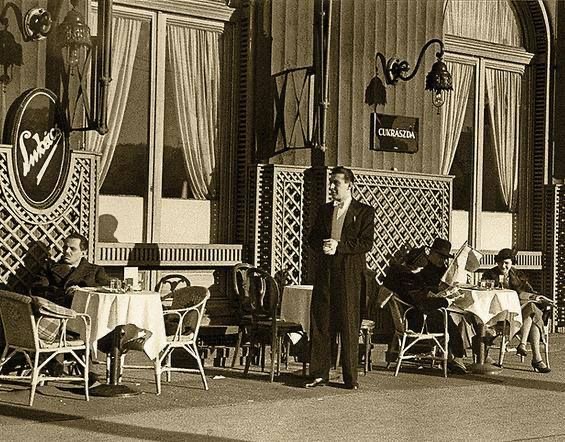
In 1932, Floris opened its flagship café and confectionery at 1 Vörösmarty Square, inside the Haas Palace. The elegant, two level interior featured modern design elements, hidden lighting, custom ceramics, and even one of the first Italian espresso machines in Budapest.
Despite its success, the company’s decline was swift. Economic difficulties, including the loss of customs benefits, the fall of the British pound, a bank collapse in Vienna, and luxury taxes on cocoa, put increasing pressure on the business. Floris Frigyes was forced to close foreign stores and eventually declare bankruptcy in Hungary as well.
The situation was worsened by false accusations against him, and in 1933 his wife, Mária Korondi, attempted suicide in the kitchen of the Vörösmarty Square confectionery. Although her life was saved, the Hungarian Floris enterprise could not be.
After the bankruptcy, the family moved to London in 1934, where they had already built a reputation. Soon after, they founded Floris Chocolate Limited, opening a chocolate shop in Soho, followed by a bakery and confectionery. The brand once again became highly successful, earning a Royal Warrant in 1959 and supplying the British royal family.
They created birthday cakes for Queen Elizabeth II and Prince Charles, and among their most famous clients was Winston Churchill, who ordered his birthday cake from them for two decades. These unique creations became major social events covered by the press each year.
After Frigyes Floris’s death in 1963, the business was continued by his wife and later by their sons until the early 1980s, when the company finally ceased operations.
Meanwhile, in Budapest, the last remaining Floris shop at Vörösmarty Square continued operating for a time, until the Haas Palace damaged during World War II was eventually demolished in 1960. A modern office building later replaced it, marking the final chapter of the Floris story in Hungary.
“With the last wall now being torn down, the story of the Haas Palace comes to an end. Not long ago, it housed the Floris confectionery, an elegant meeting place for fashionable ladies and high society.” (Esti Hírlap, August 24, 1960)